This is the various angles I took of my model. I made him do many different facial movements to give the video more dynamics.
Monday, October 25, 2010

Cubism
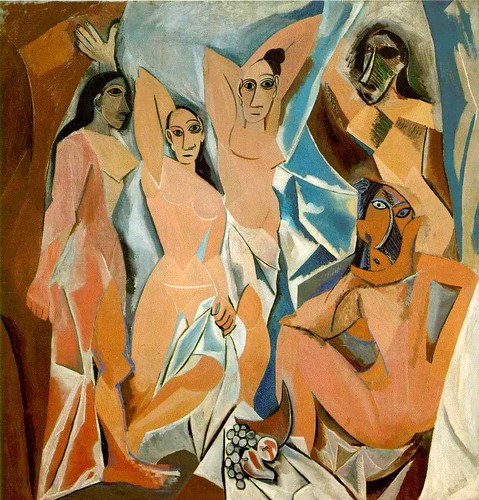
Cubism is a period of Art History (within Modernism) that sought to replicate an image of an object as seen from multiple vantage points over the course of an extended period of time. The image, as a result, looks broken and fragmented, but this forces the spectator to see what has been painted piece by piece and understand the span of time that is also represented within the work. In this way, Cubism was one of, if not THE, first movement that introduced an element of time to still art.
Method
I shot various angles to start with. Then, using about 20 instances of each video segment, I used a garbage matte to crop each instance to a different section of the clip. I layered them all and ended up with a 30 second finished clip that used over 20 different independent layers of video and took nearly 1 hours to render.
I would have liked to try and put together a entire scene with this method in such a way that every moment of the scene was happening somewhere on the screen and from many different angles (getting all of them is impossible).
I used adobe after effects, and a lot of time layering segments of video from multiple camera angles.
I would have liked to try and put together a entire scene with this method in such a way that every moment of the scene was happening somewhere on the screen and from many different angles (getting all of them is impossible).
I used adobe after effects, and a lot of time layering segments of video from multiple camera angles.
Analytic Cubism
Analytic Cubism
The first phase of Cubism, from about 1907 to 1912. Analytic cubists reduced natural forms to their basic geometric parts and then tried to reconcile these essentially three-dimensional parts with the two-dimensional picture plane. Color was greatly subdued, and paintings were nearly monochromatic. The leading cubists, Pablo Picasso (Spanish, 1881-1973) and Georges Braque (French, 1882-1963) initiated the movement when they followed the advice of Paul Cézanne (French, 1839-1906), who in 1904 said artists should treat nature "in terms of the cylinder, the sphere and the cone." Within just a few years, cubism as a method of investigation lost its intellectual rigor and became decorative and thus stylized. Nonetheless, its influence on the development of painting in the 20th century was enormous.

Analytical Cubism: Portrait of Wilhelm Uhde (1910)

One example of analytical cubism was the Portrait of Ambrose Vollard, in 1910
Project Essay
The aim of this film is to experiment on the key points of our knowledge on how Mathematics and art has influence the art movement of Cubism, in particular the geometric forms, space and perspective that was heavily used in Cubism. This is based on the critiques of Anne Gantefuhrer-Trier’s viewpoint on cubists’ ideas, describing on how cubism study of forms and space has challenged and changed the modern art world.
My project will experiment using traditional cubist ideas however I will use modern medium such as film which were not available during the cubism era.
This experiment will look more deeply into how Cubism has influenced 21th century art.
Cubism is an art movement that started during the 20th century, and it was a movement that revolutionised western paintings (Canaday, 1981). The artworks of cubism are broken down, examined, and re-created into geometric forms (Read, 2004). The artists were criticized for their curiosity in geometry, but they do claim to be more superior to previous painters as they believe that geometry, the science if science of space, its measurement and relationships, has always been the basic rule of painting (Read, 2004). Cubist artworks use multiple viewpoints instead of the usual one perspective from previous art movements and Cubists took an analytical approach to the object. Picasso was interested in mathematics as he developed his ideas using maths, through the mathematician Marice Princet (Jones, 2004).
Picasso quoted “Cubism is not either a seed or a foetus, but an art dealing primarily with forms, and when form is realized it is there to live its own life.. Mathematics, trigonometry, chemistry, psychoanalysis, music and whatnot, have been related to Cubism to give it an easier interpretation”
Geometry, which literally means ‘Earth-measuring’ is a part of mathematics principle which deals with shape, size, position of figures and space. It is one of the earliest mathematical science. Geometric shapes include circles, squares, rectangles, triangles and ellipses. Geometric forms include cones, cubes, cylinders, slabs, pyramids and spheres. Geometric Abstraction is to some extent a mistaken term for abstract art in which the image is made of non-representational geometric shapes. It has been used of various artists and movements, including the Cubism, Pablo Picasso and Georges Braque.
Since the introduction of coordinates by Rene Descartes, geometric objects can be measured analytically. Analytic geometry is usually calculated using the Cartesian coordinate system which is used to manipulate equations for planes, straight lines and squares. Moreover, there are three different dimensions in analytic geometry, one line, the Euclidean plane (2 dimensions) and Euclidean space (3 dimensions).
David George Kendal, a mathematician and statistician have described as geometric shape: “Shape is all the geometrical information that remains when location, scale and rotational effects are filtered out from an object.”
In this body of work I have used my own face as the subject. With the use of video editing, the clip shows a broken and fragment pieces of my face. This is done to replicate an image of an object which is seen from multiple vantage points. This makes the viewer of the work to see and analysed each ‘panel’ piece by piece and understand period of time that is also represented in the video. I transform the idea into visual clips of geometrical elements fragmenting the theme to show different views. I created the video using cubism fundamentals with the use of geometric shaped panels. Within these panels are bits of my face filmed from various angles and pieced them together. I have tried to replicate the style of analytic cubism, breaking down my face into forms to a great extent that makes it look ambiguous. But the forms are still somewhat structured to a normal human face. This makes the video just recognisable so the viewer can still identify that is it a representation of a face. There are some panels that appear to be unproportional, which is the result of multiple viewpoints. The colours are reduced greatly within the video. Colours are almost non-existent in analytical cubism making is monochromatic. The lack attention of colour forces the viewer to concentrate on the investigation of form and space. In addition, the spatial multiple viewpoints give an ambiguous reading of space. In addition, because of the multiple viewpoints the work itself gives an illusion of a 3 dimensional space (Euclidean) while all the panels are all actually on 1 plane (Euclidean plane). The space has been restructured and simplified. Space has also been flattened by overlapping the objects and cramping them to make things appear closer to the viewer (Calter, 1998). None of the objects are fully enclosed, the gaps between the outline and the forms are called the passage and they are not definite. This technique is also used in order to lead the viewer’s eye around the work (Gantefuhrer, 2004).
In conclusion, with their experiments and studies of mathematics using form and space, cubism has proved to be most likely the most powerful generative energy in the 20th century art. The movement also changed people’s ideas relating to purpose and possibilities of pictorial representation. If ever you are stuck on an idea for a project, I would recommend looking back to the early masters and ask yourself this, "If they were alive today, how might they use the technology available to you that hadn't even been dreamed up then?"
My project will experiment using traditional cubist ideas however I will use modern medium such as film which were not available during the cubism era.
This experiment will look more deeply into how Cubism has influenced 21th century art.
Cubism is an art movement that started during the 20th century, and it was a movement that revolutionised western paintings (Canaday, 1981). The artworks of cubism are broken down, examined, and re-created into geometric forms (Read, 2004). The artists were criticized for their curiosity in geometry, but they do claim to be more superior to previous painters as they believe that geometry, the science if science of space, its measurement and relationships, has always been the basic rule of painting (Read, 2004). Cubist artworks use multiple viewpoints instead of the usual one perspective from previous art movements and Cubists took an analytical approach to the object. Picasso was interested in mathematics as he developed his ideas using maths, through the mathematician Marice Princet (Jones, 2004).
Picasso quoted “Cubism is not either a seed or a foetus, but an art dealing primarily with forms, and when form is realized it is there to live its own life.. Mathematics, trigonometry, chemistry, psychoanalysis, music and whatnot, have been related to Cubism to give it an easier interpretation”
Geometry, which literally means ‘Earth-measuring’ is a part of mathematics principle which deals with shape, size, position of figures and space. It is one of the earliest mathematical science. Geometric shapes include circles, squares, rectangles, triangles and ellipses. Geometric forms include cones, cubes, cylinders, slabs, pyramids and spheres. Geometric Abstraction is to some extent a mistaken term for abstract art in which the image is made of non-representational geometric shapes. It has been used of various artists and movements, including the Cubism, Pablo Picasso and Georges Braque.
Since the introduction of coordinates by Rene Descartes, geometric objects can be measured analytically. Analytic geometry is usually calculated using the Cartesian coordinate system which is used to manipulate equations for planes, straight lines and squares. Moreover, there are three different dimensions in analytic geometry, one line, the Euclidean plane (2 dimensions) and Euclidean space (3 dimensions).
David George Kendal, a mathematician and statistician have described as geometric shape: “Shape is all the geometrical information that remains when location, scale and rotational effects are filtered out from an object.”
In this body of work I have used my own face as the subject. With the use of video editing, the clip shows a broken and fragment pieces of my face. This is done to replicate an image of an object which is seen from multiple vantage points. This makes the viewer of the work to see and analysed each ‘panel’ piece by piece and understand period of time that is also represented in the video. I transform the idea into visual clips of geometrical elements fragmenting the theme to show different views. I created the video using cubism fundamentals with the use of geometric shaped panels. Within these panels are bits of my face filmed from various angles and pieced them together. I have tried to replicate the style of analytic cubism, breaking down my face into forms to a great extent that makes it look ambiguous. But the forms are still somewhat structured to a normal human face. This makes the video just recognisable so the viewer can still identify that is it a representation of a face. There are some panels that appear to be unproportional, which is the result of multiple viewpoints. The colours are reduced greatly within the video. Colours are almost non-existent in analytical cubism making is monochromatic. The lack attention of colour forces the viewer to concentrate on the investigation of form and space. In addition, the spatial multiple viewpoints give an ambiguous reading of space. In addition, because of the multiple viewpoints the work itself gives an illusion of a 3 dimensional space (Euclidean) while all the panels are all actually on 1 plane (Euclidean plane). The space has been restructured and simplified. Space has also been flattened by overlapping the objects and cramping them to make things appear closer to the viewer (Calter, 1998). None of the objects are fully enclosed, the gaps between the outline and the forms are called the passage and they are not definite. This technique is also used in order to lead the viewer’s eye around the work (Gantefuhrer, 2004).
In conclusion, with their experiments and studies of mathematics using form and space, cubism has proved to be most likely the most powerful generative energy in the 20th century art. The movement also changed people’s ideas relating to purpose and possibilities of pictorial representation. If ever you are stuck on an idea for a project, I would recommend looking back to the early masters and ask yourself this, "If they were alive today, how might they use the technology available to you that hadn't even been dreamed up then?"
Subscribe to:
Posts (Atom)